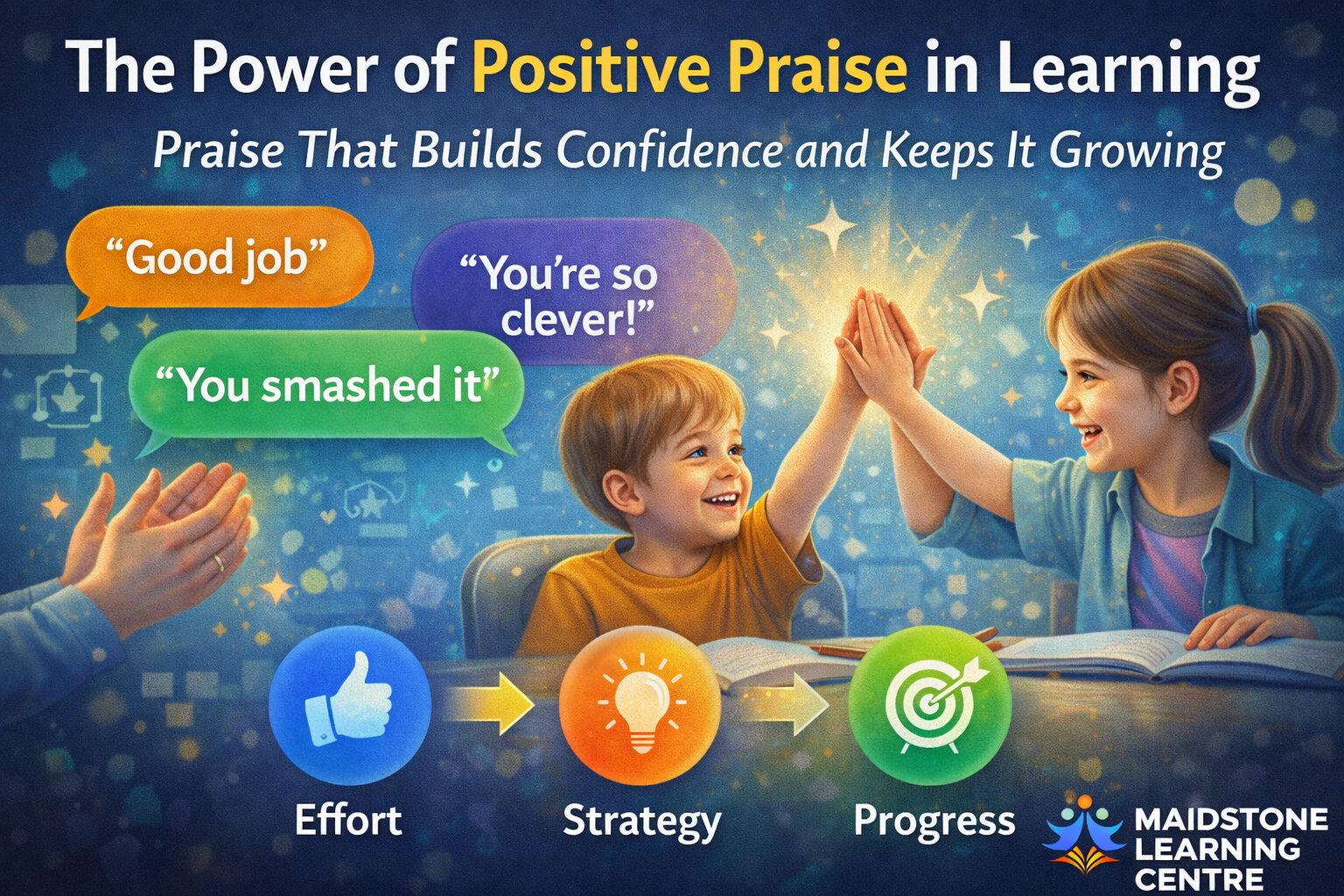
The Power of Positive Praise in Learning
Praise That Builds Confidence and Keeps It Growing
“Good job”
“You’re so clever”
“You smashed it”
We all want to encourage our children. But not all praise has the same effect. Some praise can build long-term motivation and resilience while other types, though well-meaning, can create pressure or fear of failure.
At Maidstone Learning Centre, we use positive praise every single day not just to reward effort, but to build confidence, independence, and a love of learning that sticks.
Here’s how it works and how you can use it at home too.
Why Praise Matters in Learning
When children hear encouragement from trusted adults, they:
- Feel recognised and valued
- Associate effort with achievement
- Build confidence to try again
- Are more likely to take on new challenges
- Develop a stronger sense of identity as a “learner”
But here’s the key: the type of praise matters just as much as the words themselves.
Effort vs Outcome: The Praise That Builds Resilience
Many of us were raised on praise like:
- “You’re so smart”
- “You got 10 out of 10! Brilliant”
While this feels positive, it often leads to a fixed mindset the idea that success depends on being naturally good at something. Children may start to fear getting things wrong, or believe they’re only “clever” if things are easy.
Instead, we use praise that builds a growth mindset, the belief that effort and strategies lead to improvement:
- “I can see how hard you worked on that.”
- “You didn’t give up that made the difference.”
- “That mistake helped you figure out the next step. Great thinking”
The Problem with Overpraising
Sometimes, too much praise (or praise for everything) can backfire. Children may:
- Seek constant approval
- Avoid tasks they’re not immediately good at
- Feel anxious when praise is not given
That’s why we focus on authentic, specific praise; it’s not about flattery. It’s about helping children notice what they did that worked, so they can do it again.
What Effective Praise Looks Like
Here are some phrases you can try at home:
“I noticed you kept going even when it got tricky.”
“You tried a different method that’s great problem-solving.”
“That’s a big improvement from last time what do you think helped?”
“It’s okay that it wasn’t perfect. The important thing is you gave it a go.”
The goal isn’t to sugar-coat everything. It’s to reinforce effort, strategies, and progress, the things children can control.
How MLC Uses Praise to Motivate Learners
In our sessions, we build praise into everything we do from how we greet students to how we review their work:
Small wins matter -A brave answer, improved focus, or showing kindness all get noticed.
Praise is tied to process -“You explained your thinking clearly,” not just “Well done.”
We include student voice – “What are you proud of today?” helps them internalise success.
Mistakes are framed positively – “You learned something new here.”
We’ve seen how praise can shift a child from “I’m not good at this” to “I’m getting better at this.”
Final Thought: Make Praise a Tool, Not a Crutch
Positive praise isn’t about inflating egos. It’s about reinforcing growth, effort, and reflection.
When children learn why something worked and feel safe to try, fail, and try again; they start to praise themselves. And that’s the most powerful praise of all.