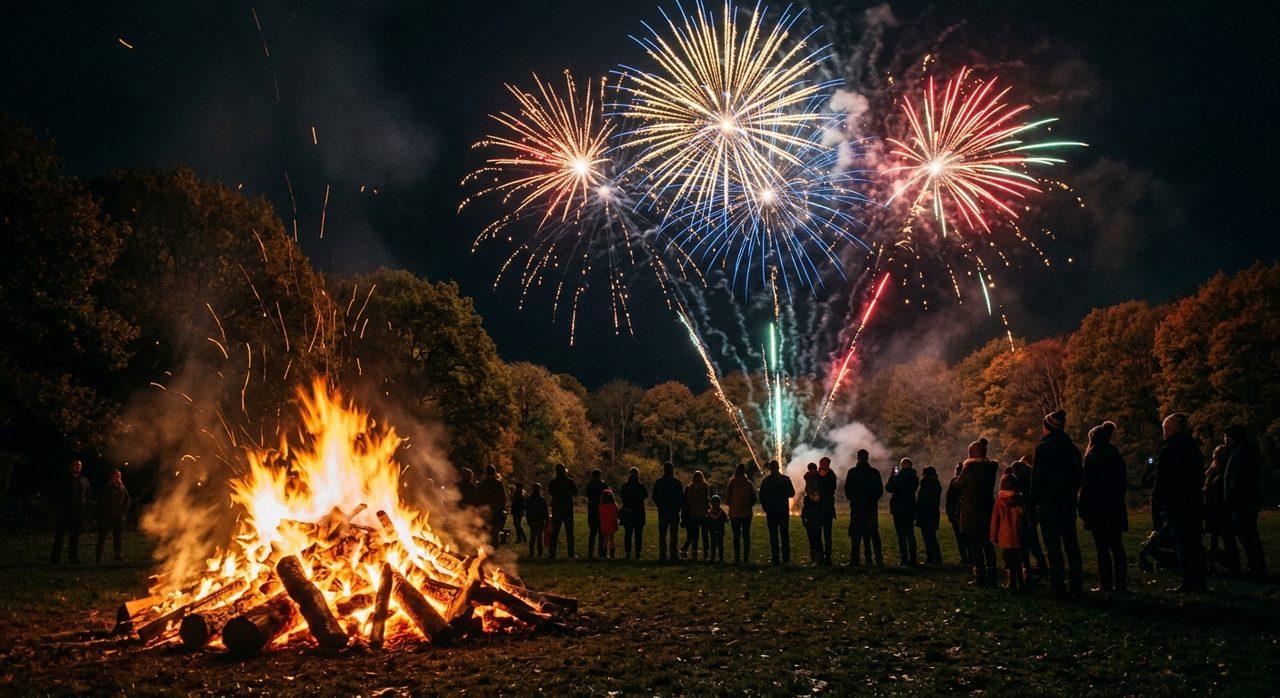
Bonfire Night Learning: Turning Seasonal Excitement into Reading, Writing and Science
Bonfire Night is more than an evening of fireworks. It gives families a rich opportunity to connect history, science, vocabulary, creative writing and practical safety in ways that feel memorable rather than forced.
Children often learn best when a topic is already alive in their imagination. The flash of fireworks, the smell of smoke and the story of the Gunpowder Plot provide vivid material for discussion across several age groups.
1. Begin with the History
Ask your child what they already know about 5 November 1605.
- Who was Guy Fawkes?
- What was the Gunpowder Plot?
- Why do people still mark the date?
Encourage them to separate historical facts from traditions and to recognise that historical events can be interpreted from more than one point of view.
Older pupils can compare two short accounts and ask:
- Whose perspective is represented?
- Which details are emphasised?
- What evidence is missing?
These are valuable comprehension and source-analysis skills.
2. Explore the Science of Fireworks
Fireworks link naturally to Chemistry and Physics. Their colours are produced by different chemical compounds, while their movement, sound and light invite discussions about energy, forces and waves.
Children do not need dangerous demonstrations to explore these ideas safely.
Try these simple learning activities:
- Explore firework colours: Research which compounds can produce red, green, blue or gold colours.
- Investigate sound and light: Discuss why light is seen before a distant bang is heard.
- Estimate distance: Use the delay between a flash and its sound to estimate how far away a firework is.
- Explore sound patterns: Investigate why some fireworks whistle while others crackle or burst.
3. Use Sensory Details in Writing
Invite younger pupils to collect powerful verbs, adjectives and sound words, such as:
fizzed, streaked, thundered, dazzling, smoky and deafening.
Then ask them to write a short description that helps a reader see, hear and feel the scene.
For GCSE English Language students, take the activity further:
- Vary sentence lengths to create different effects.
- Create a deliberate shift in mood.
- Choose imagery carefully to engage the reader.
- Use a one-sentence paragraph to capture the pause before an explosion.
- Use a longer sentence to mirror a firework unfolding across the sky.
This helps children develop descriptive writing techniques while enjoying a familiar seasonal topic.
4. Keep Safety Part of the Learning
The strongest educational activity is never worth compromising safety.
- Attend organised displays where possible.
- Supervise children closely.
- Follow the event organiser’s instructions.
- Make firework safety rules clear and age appropriate.
If discussing fireworks at home, remind children that fireworks should only be handled by responsible adults in accordance with safety guidance.
5. Turn Seasonal Excitement into Meaningful Learning
Seasonal learning works because it connects school skills with real life.
One thoughtful conversation can strengthen vocabulary, curiosity and confidence without feeling like extra homework.
Whether your child is developing reading comprehension, exploring scientific concepts or building creative-writing skills, Bonfire Night offers an opportunity to make learning engaging and memorable.
Make everyday moments count. Look for opportunities to turn the world around your child into a classroom filled with curiosity, discovery and creativity.
Stay Connected with Maidstone Learning Centre
Follow Maidstone Learning Centre for practical activities, learning tips and creative ideas that turn everyday family moments into meaningful learning experiences.