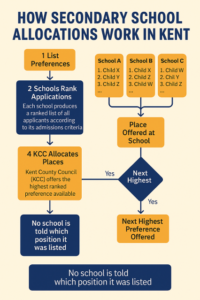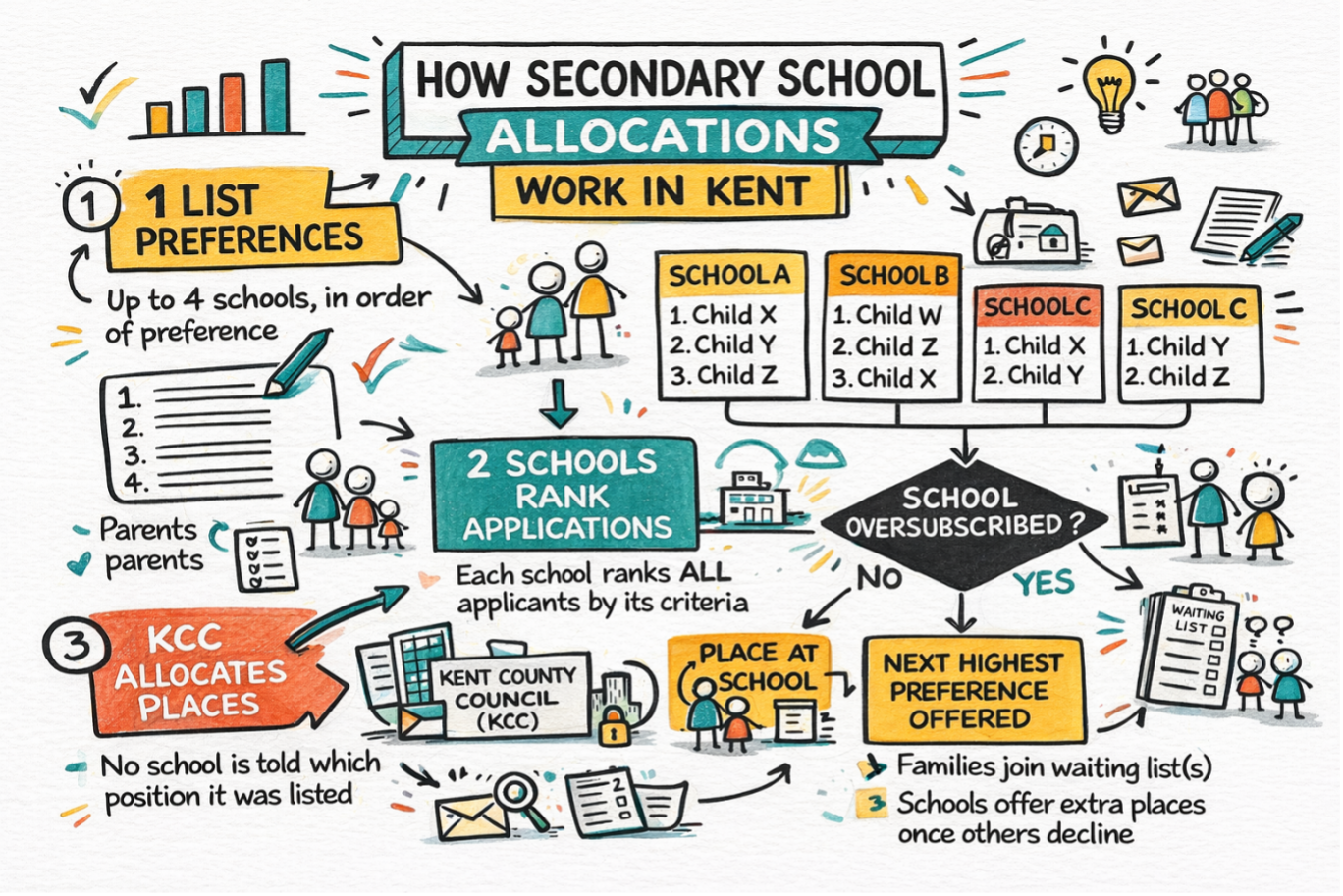
How secondary school allocations actually work in Kent (including grammar school preferences and “first choice” myths):
Your first choice does not give you priority over someone else who listed the same school second or third.
What matters is whether your child meets the school’s admission criteria.
Kent (like the rest of England) uses an “equal preference system.”
How the “Equal Preference System” Works
- You rank your schools on the Kent Secondary Common Application Form (SCAF) — usually up to four preferences.
- You can include both grammar and non-selective schools.
- List them in your genuine order of preference — from the one you want most (1st) to least (4th).
- Each school is treated as if it were your only application.
- Kent County Council sends your child’s details to each school (or academy trust) you’ve listed.
- Each school applies its admissions criteria independently — without knowing what position you listed them.
For example:
-
- A grammar school will look at whether your child passed the 11+ and meets any distance/sibling criteria.
- A non-selective school will look at distance, siblings, feeder primaries, or catchment.
- Each school produces a ranked list of all applicants based on their admissions criteria — not your preference order.
- The council’s system then:
- Offers you a place at the highest-ranked school on your list for which your child qualifies.
- Withdraws any lower preferences automatically.
Example
Let’s say you list:
1️⃣ Maidstone Grammar School for Girls
2️⃣ Invicta Grammar School
3️⃣ Cornwallis Academy
- Your child passes the Kent Test and meets Invicta’s distance criteria but not Maidstone Grammar’s.
➡️ You will get a place at Invicta, because it’s the next highest school on your list for which your child qualifies. - Even if someone else listed Invicta as their first choice, it doesn’t push you down the list. The ranking is purely by criteria.
Common Myths
| Myth | Reality |
| “If I don’t put the grammar school first, I’ll lose my chance.” | ❌ False. Grammar schools can’t see your preference order. |
| “Putting a non-selective first will stop me getting a grammar.” | ❌ False. Each school considers applications separately. |
| “Listing a school twice helps my chances.” | ❌ Doesn’t — only your first valid entry counts. |
Timeline (Kent Example)
| Stage | Approx Date |
| Apply online | By 31 October 2025 |
| School allocation offers | 1 March 2026 |
| Deadline to accept/refuse | Mid-March |
| Appeals & waiting lists | Spring–Summer term |
Top Tips
✅ Always put your genuine first choice first — not the one you think you’re “most likely to get.”
✅ Include at least one “safe” non-selective option you’re almost guaranteed to qualify for.
✅ Check each school’s admissions policy carefully (distance, siblings, parish boundaries, etc.).
✅ Grammar applicants — ensure you’ve registered and passed the Kent Test before applying.
What happens to the other schools on my list, do they get given to others? Do the schools only choose as many as they have on their allocation or more knowing some will drop off?
Key Point:
Each school ranks all applicants, not just the number of places they have — and they don’t give out offers themselves.
The local authority (Kent County Council) does the matching and makes one offer per child.
Here’s what actually happens behind the scenes:
1️⃣ Every school creates a ranked list of all applicants.
- Let’s say a grammar school has 150 places.
- It might receive 600 applications.
- It ranks all 600 based on its admission criteria (11+ score, distance, siblings, etc.).
So — the school has:
- Rank #1 → child who lives closest or scored highest
- Rank #2 → next in order
- …all the way to Rank #600
They don’t stop at 150 because they know some children will get higher-preference offers elsewhere and drop off.
2️⃣ Kent County Council runs a computerised allocation process.
It goes round in several stages:
- Stage 1: Each school provisionally “offers” places to their top-ranked applicants up to their capacity (e.g. top 150).
- Stage 2: If a child is on the provisional list for more than one school (because they qualify for several), the system gives them the one they ranked highest on their form.
- Stage 3: When that happens, their name is removed from the lower-preference schools’ lists — freeing up space for the next child down the ranking.
- This continues in rounds until every child has one offer and no school exceeds its capacity.
3️⃣ So yes:
✅ Schools rank everyone, not just their capacity.
✅ Kent County Council makes sure no school offers more than it can take.
✅ Once you’re offered a higher preference, you’re automatically withdrawn from lower ones.
✅ The “freed-up” places go to the next child on that school’s list — so yes, your lower-choice schools’ places do get given to others.
4️⃣ Waiting lists after 1 March
After offers are released:
- You can join waiting lists for schools higher up on your list that you didn’t get.
- Waiting lists are re-ranked using the same admissions criteria, not first come, first served.
- Schools often make additional offers later as families accept places elsewhere.
Example
Imagine:
- You list:
1️⃣ Maidstone Grammar
2️⃣ Invicta Grammar
3️⃣ Maplesden Noakes - You qualify for all three, but Invicta is the only one with space.
Kent County Council offers you Invicta (your 2nd choice).
Your name is then removed from Maidstone and Maplesden lists.
Those freed-up slots go to the next child down their waiting list.
In summary:
| Step | Who decides | What happens |
| Ranking | Each school | Ranks all applicants by criteria |
| Allocation | Kent County Council | Matches each child to their highest eligible preference |
| Capacity control | Kent County Council | No school exceeds its PAN (Published Admission Number) |
| Waiting list | School or council | Used to fill declined offers |